We’ve officially moved past the era of "digital transformation" as a buzzword and into the reality of the agentic AI economy. As we navigate 2026, the traditional boundaries of Learning & Development (L&D) have dissolved. L&D is no longer a peripheral support function; it has emerged as the central operating system for organizational resilience.
From the collapse of traditional job titles to the rise of AI teammates, the strategies we once forecasted are now the daily requirements for staying competitive. According to the Coursera Global Skills Report, we are seeing a 195% year-over-year increase in GenAI-related enrollments. But the real story is a 28% spike in critical thinking—the human "guardrail" for machine output.
Here is how the most successful organizations are mastering workforce development right now:
1. The Reality of Retention through Development
In today’s market, the talent value proposition has shifted. Continuous learning and clear internal mobility aren't just HR perks. They are the primary tools for employee retention.
- The New Loyalty: Employees are staying with organizations that offer constant upskilling. Gartner’s 2026 talent research highlights that Gen Z now values job mobility over job security; if they can't move up or around internally, they move out.
- Succession in Real-Time: We’ve moved away from static annual reviews to dynamic succession strategies that constantly "warmed up" internal talent for the next move.
“The greatest transformation comes as organizations redesign workflows from the ground up around AI and invest in advanced human skills. It is no longer about task automation, but process orchestration.”
— Nathan Jokel, SVP of Corporate Strategy, Cisco (via WEF 2026)
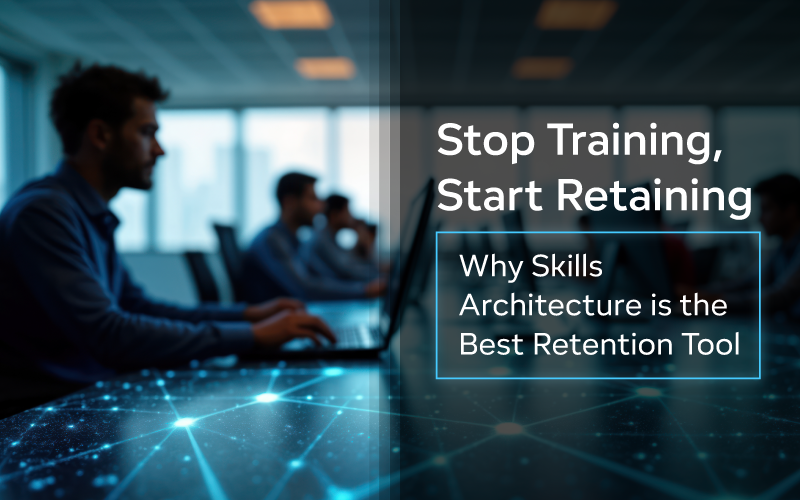
2. Living in a Skills-First Architecture
The "job title" is officially a legacy concept. Successful 2026 firms have fully transitioned to granular skills mapping.
- Precision Learning: Instead of broad, wasteful training cycles, we are seeing hyper-efficient, "n=1" learning interventions. We don't train "Managers"; we bridge specific gaps in "Conflict Resolution" or "Data-Driven Coaching" at the exact moment they are needed.
- Internal Marketplaces: The internal talent marketplace is now the core operating system, allowing leaders to deploy skills to projects in real time, effectively closing talent gaps without the lag of external hiring.
3. AI: From Tool to Digital Teammate
We’ve moved beyond how to prompt. This year is defined by workflow redesign and AI collaboration.
- Agentic AI Management: L&D’s biggest lift right now is teaching the workforce how to manage agentic-AI, i.e., digital teammates that can execute tasks autonomously.
- The Judgment Shift: Training now focuses heavily on critical validation. As AI handles the doing, the human's role has evolved into the editor-in-chief, responsible for the ethics, security, and accuracy of AI-generated outcomes. Coursera’s 2026 data confirms that "critical thinking" and "AI personalization" are now the two fastest-growing skills in the data sector.
4. The Adaptive Leadership Mandate
2026 has proven that stiff leadership is a liability. As noted by Harvard Business School faculty, change fitness has become the ultimate AI differentiator.
- Contextual Awareness (CXA): The most critical skill of the year. Leaders must translate massive amounts of decentralized data and AI insights into a proactive strategy.
- The Flexibility Balance: We’ve learned that adaptability doesn't mean whiplash. Successful leaders are providing the why behind every shift, ensuring teams stay grounded even as the how of their work changes weekly.
5. Soft Skills: The Hardest Currency
As AI automates cognitive heavy lifting, the distinctly human capabilities—empathy, ethical judgment, and complex negotiation—have become our most valuable assets. We are seeing a massive swing back to high-touch, in-person, or synchronous human learning to sharpen these irreplaceable traits.
The Bottom Line
In 2026, the best L&D leaders will become operational product partners. They aren't counting course completions; they are measuring time to proficiency and revenue influence. The workforce isn't just trained—it is an agile, skill-mapped machine capable of pivoting as fast as the technology does.
Learn more about ELB's business transformation services.