AI is moving into the workplace at an alarming pace. All of a sudden, there are new tools, workflows, and expectations. And most of us are sitting around like, “Wait… am I supposed to know how to use this now?”
The short answer is: yup.
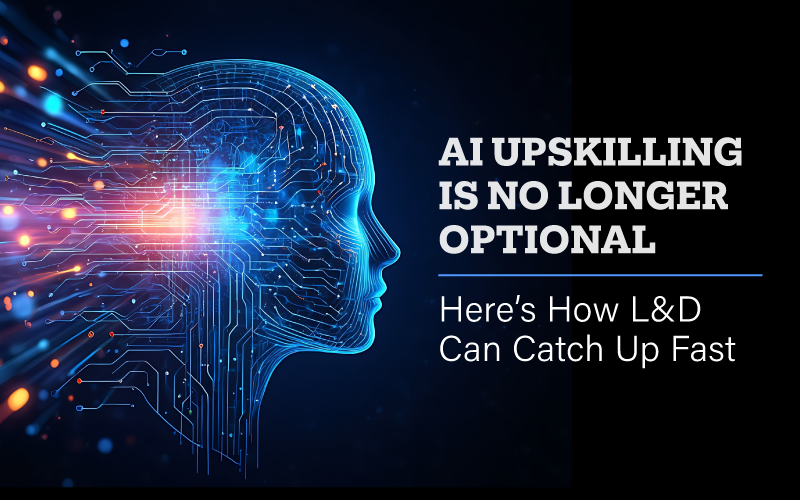
AI upskilling is no longer a nice-to-have. It’s quickly becoming the difference between organizations that adapt and organizations that scramble.
The good news? L&D teams don’t need to launch a year-long AI academy to make progress. You can start small, fast, and strategically.
AI isn’t just changing jobs, it’s changing how work gets done. LinkedIn’s 2025 Workplace Learning Report points to L&D as a key driver of agility as AI reshapes the workforce. And broader workforce trends show that employers are prioritizing reskilling as AI (and other new technologies) accelerate skill disruption.
In other words, teams aren’t just learning new tools; they’re learning new ways of thinking, creating, and solving problems.
The Real AI Skills Gap Isn’t Technical
When leaders say “we need AI skills,” they’re usually talking about coding, automation, or advanced data science. But for most employees, the real gap looks more like knowing when to use AI, writing better prompts, checking AI output for quality and bias, using AI safely with company data, and applying AI to real workflows (not random experiments).
That’s why AI upskilling shouldn’t be treated like a one-time thing. It works best as a practical learning journey, built around job tasks employees already complete.
Three Quick Wins: How to Start AI Upskilling This Week:
| 1. | Teach them to be fluent, not masterful. Most employees don’t need (or want) extensive technical training; they just need a baseline understanding of what AI is, what it can and can’t do, and how it should be used responsibly. | |
|
Think of it as teaching people to drive, not how to build an engine. |
||
|
Even a short lesson covering AI basics, with examples broken down by role (or use case), can reduce anxiety and increase adoption. |
||
| 2. |
Teach them how to write effective prompts. Writing useful AI prompts isn’t about clever tricks; it’s really about clarity. |
|
|
A quick AI prompt lesson could include details on how to use AI tools to develop a better first draft, request a rewrite in a certain tone, get a summary with action items, or check accuracy before anything goes out. |
||
|
Research from the Society for Human Resource Management (SHRM) shows that learning is most effective when it’s timely and embedded into real workflows (otherwise known as the work employees already do on a daily basis). |
||
| 3. | Add guardrails for safety and privacy (with examples of what not to do). AI adoption speeds up significantly when people feel confident. And confidence comes from establishing these types of clear boundaries. |
Include simple rules like what’s okay to share with your AI assistants, what’s off-limits (customer info, confidential data), how to verify output before using it externally, and how to avoid accidental bias or misinformation. This doesn’t have to be heavy or intimidating. A simple, one-page “AI use policy” document is an excellent tool to provide clarity and comfort. And if you could infuse relevant use-case scenarios, that would paint an even clearer picture.
What Great AI Upskilling Looks Like
AI training works best when it includes microlearning for quick skill-building, practice activities tied to real job tasks, coaching, or job aids people can use immediately, and ongoing reinforcement (because the tools keep changing). Many organizations are seeing AI adoption outpace workforce readiness, making support and enablement more important than ever.
How ELB Learning Can Help You Upskill for AI
The best AI learning programs don’t just explain what AI is; they help employees use it confidently at work. At ELB Learning, we help organizations design role-based AI upskilling strategies, build training that fits modern workflows, and deliver practical learning experiences that drive adoption.
If you’re looking for a fast, realistic way to help your workforce build AI confidence, we’re here to help.
If you’re ready to get started, check out our AI transformation services and see how we can help you design AI training that’s super sticky.