Picture this: You walk into a high-end restaurant, prepared to pay top dollar for a memorable meal, when the waiter saunters in and plops a sack of raw potatoes atop your minimal tablescape and says, “There you go! Plenty of value in there!” You’d probably walk out mumbling a few choice words. And that’s only if you were feeling generous. But when you think about it, corporate learning and development (L&D) used to operate on a very similar principle. Training was measured by its physical weight, not by how well it nourished the mind or altered behavior.
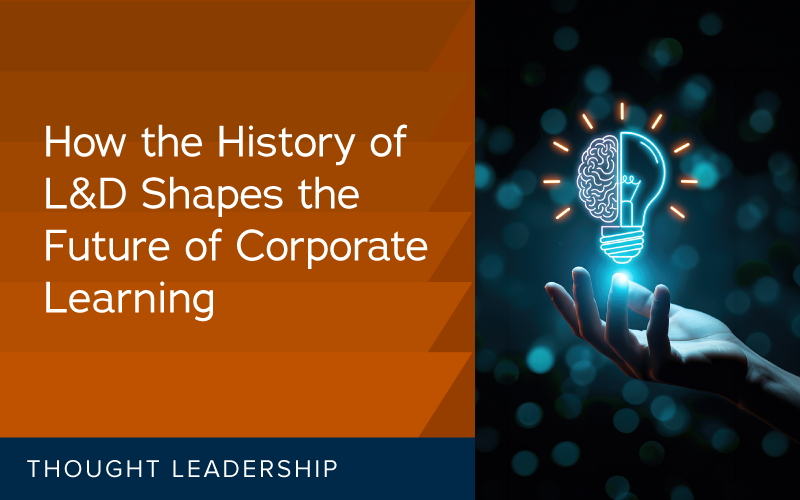
To understand why modern corporate training looks, feels, and sometimes frustrates us the way it does, we have to look back at where it all began. In a recent webinar, The eLearning Cheat Code: A Fast Track to L&D Credibility, Brent Schlenker—a 25-year learning and development veteran and former executive at companies like Intel and Litmus—unpacked this history. By examining how we moved from the heavy "thud" factor of paper binders to the algorithmic precision of artificial intelligence, we can better understand how to design impactful learning experiences today.
The hardware hall of fame and the “volume” legacy
Long before the cloud, corporate learning lived in filing cabinets, carousel slide projectors, and those gigantic three-ring binders. If a stakeholder held a training manual and it felt heavy in his hand, he believed he was getting his money’s worth.
Volume was explicitly correlated with value.
This historical mindset explains why clients still ask for a comprehensive, one-hour eLearning course when a simple, five-minute video or job aid would suffice. Corporate culture is still conditioned to believe that duration equals value.
In 1985, the average corporate training department spent roughly 60% of its budget purely on travel and logistics. L&D functioned almost like an internal travel agency, flying employees across the country to sit in hotel conference rooms. Because everything was printed, there was no edit button. A single typo discovered on page four of 5,000 printed manuals meant having to decide between a $10,000 reprint and hiring an intern to apply corrective tape to every copy manually. This dynamic birthed a culture of rigid perfectionism—and a slow development cycle—that the industry is still actively trying to unlearn.
Era One: The compliance era and the birth of the checkbox
In the 1990s, the core driver of corporate training shifted dramatically from skill-building to risk mitigation. It didn’t start with an instructional breakthrough; it started with a series of major legal rulings. Courts established that employers could he held liable for the misconduct of their managers unless they could prove an affirmative defense. If an organization could document that it had trained its staff, its financial liability was drastically reduced. The Federal Sentencing Guidelines of 1991 solidified this reality.
Overnight, training became an insurance policy.
The completion certificate became a legal shield, which gave birth to the checkbox culture. The Learning management system (LMS) rose to prominence during this period, not primarily as a tool to foster deep cognitive understanding, but as an auditing engine to protect organizations from liability.
Era Two: The content era and the democratization of boring
As shipping physical CD-ROMs with custom, mini-video-game production budgets proved unsustainable, the industry transitioned into the content era (2005–2015). This phase was defined by the rapid expansion of off-the-shelf digital content libraries and the emergence of rapid authoring software.
Suddenly, anyone could take a 150-slide technical PowerPoint presentation, and the mandatory next button, and publish it as an eLearning module. Welcome to the democratization of boring. To ensure compliance, designers began locking navigation buttons, forcing users to sit on a slide for 60 seconds before they could progress.
When organizations realized that employees were avoiding these massive libraries, the industry attempted to apply a gamification band-aid in the early 2010s. Leaderboards, points, and digital badges were added to unengaging content, inadvertently cheapening the concept of engagement. This era reinforced a critical lesson: technology is merely the delivery truck. If the cargo inside the truck isn’t instructionally sound, putting it inside a flashier vehicle won’t change its value.
Era Three: The experience, skills, and AI era (aka, now)
Today, the workplace is moving from an environment of static know-it-alls to a dynamic culture of learn-it-alls. The strict monopoly that L&D departments once held over organizational knowledge has vanished. If an employee needs to learn how to create a pivot table in Excel, they’ll look it up instantly on the phone rather than waiting for a scheduled corporate seminar. Training is an isolated event, but learning is a continuous, spontaneous process. Modern L&D must focus on providing in-the-moment, context-aware resources embedded directly into the flow of work.
The Future of Learning
As AI begins to map complex skills ontologies and simulate real-time roleplay scenarios, the role of the instructional designer is shifting. The priority is no longer just authoring basic information, but curating, validating, and structuring clean data to feed these intelligent systems.
At ELB Learning, we build solutions designed for this modern landscape to ensure your training moves past empty checkboxes to drive authentic performance improvement. Whether you need custom instructional design, advanced learning games, or immersive technology, our ecosystem is built to replace the heavy, outdated "thud" factor with measurable business impact.
Watch the complete webinar below for the full historical context and insights firsthand. If you want to modernize your training strategy, contact us today to discover how our solutions and services can elevate your organization’s learning experience.
_______________
Disclaimer: The ideas, perspectives, and strategies shared in this article reflect the expertise of our featured speaker, Brent Schlenker, M.Ed. Be sure to follow him on LinkedIn to explore more of his insights.